 Healthy
Firefighters need to be protected.
Firefighters face a great risk of occupational diseases and should be safeguarded. Healthy Firefighters shows why, how and what can be done to prevent firefighter occupational cancer and other diseases.
Read the free e-book Get in touch
Clean and protective clothing
Firefighters should be able to start their shift in full, clean protective clothing, and be able to protect their airways and skin in all situations. Gear, equipment, and tools should be decontaminated every time they have been exposed to products of combustion. It is also essential that routines separate contaminated items from clean ones when transporting and when handling at the fire station.
The Skellefteå Model
Healthy Firefighters – the Skellefteå Model (also written Skelleftea Model; in Swedish, Skelleftemodellen) is a collaborative project aimed at preventing occupational health hazards among firefighters. Now adopted as the standard in 17 European countries, the project provides concise decontamination protocols which can improve firefighters' health and well-being.
The Healthy Firefighters project and the Skellefteå Model were started in Skellefteå, Sweden, in 2006 by unions, employers and agencies.
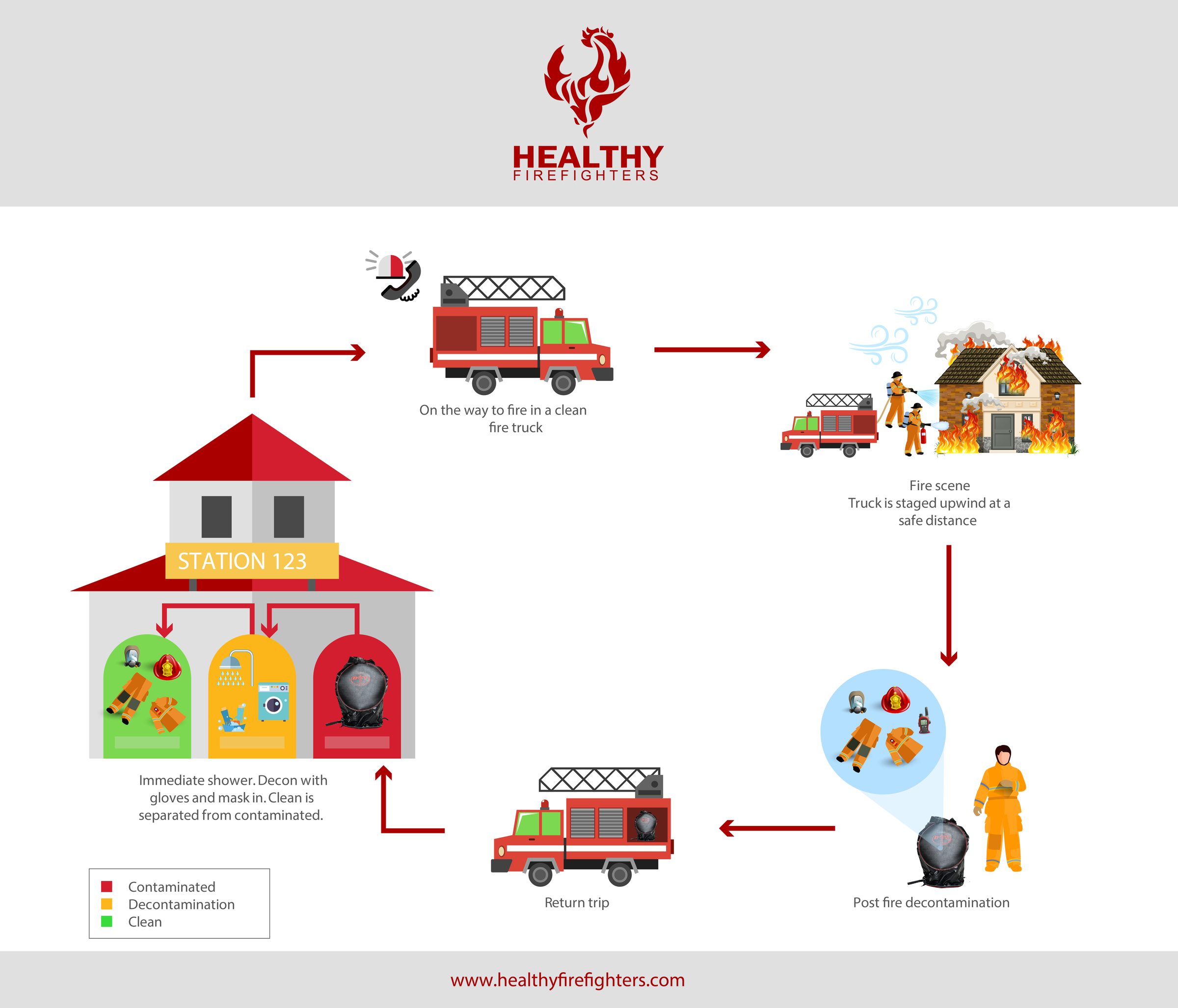
How the Skellefteå Model works, step by step
- Clean startThe crew responds in a clean fire truck, in full, clean protective clothing.
- At the fire sceneThe truck is staged upwind at a safe distance from smoke and products of combustion.
- Post-fire decontaminationContaminated gear is taken off at the scene and sealed in airtight bags, and the crew changes into clean clothes.
- Return tripContaminated gear travels sealed and separated from the crew, never loose in the cab.
- Back at the stationImmediate shower. Gear is decontaminated with gloves and mask, and clean is kept separated from contaminated.
Three things make it work
How to prevent firefighter cancer
Firefighters are exposed to carcinogens through the skin and airways, during the fire and long after it, from contaminated gear. Most of that exposure can be reduced with simple routines.
- Start every shift in clean gear and keep a set of clean clothes on the truck.
- Protect airways and skin in all situations, also during overhaul and investigation.
- Reduce contamination on scene: remove gear carefully and clean exposed skin before leaving.
- Seal contaminated gear in bags and transport it outside the crew cab, so it cannot off-gas where people sit.
- Separate clean from contaminated at the station, with clear zones for each.
- Shower and change as soon as possible after the call, and wash gear before it is used again.
The US National Institute for Occupational Safety and Health gives the same advice on bagging gear and keeping it out of the cab: NIOSH, Protecting Firefighters from Contaminated Gear (2026).
Videos
See how the Skellefteå Model works in practice.
The video referenced in the European standard EN 469:2020, Annex B.4.
Free e-book
This book provides examples and practical tips on how a fire & rescue service, with simple means, can reduce the amount of contaminants that personnel are exposed to – and thereby achieve a better work environment and improved health for firefighters and other fire & rescue service personnel.
Get in touch
Questions about the Skellefteå Model or sponsorship? Your support can have a direct impact on promoting and strengthening firefighters' health. Do you have a product that improves firefighters' health? Contact us.
Follow us